Monk Took Book Free Download PC – Complete Game Guide
Monk Took Book Free Download PC is a cozy-creepy medieval library simulation that combines organization, memory, management, exploration, physics-based interactions, and light combat. Developed and published by SquarePlay Games, the game takes players to Holy Island, where they become a novice responsible for managing a mysterious monastic library and completing its Legendary Collection. The full game was released on September 3, 2026, and supports both solo play and online co-op for up to four players.
Unlike conventional management games, Monk Took Book makes remembering the location of hundreds of books part of the core challenge. Every morning, new books arrive with symbols rather than conventional titles. Players decide where to organize them, remember their locations, and later retrieve specific volumes for the Scribes.
When night arrives, however, the peaceful library can become dangerous. Vermin, spirits, beasts, fires, and other threats can put your collection at risk. Depending on your preferred play style, you can fight back with weapons, repair damaged books, upgrade your monk, or reduce the intensity of the enemies and focus on library management.
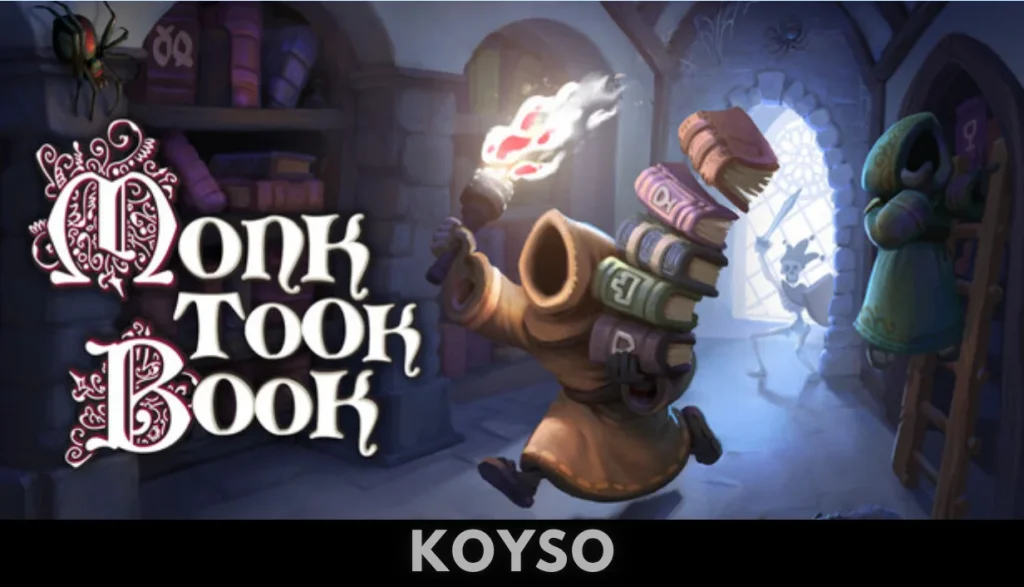
Monk Took Book PC Download Overview
Monk Took Book is designed around a simple idea: organizing a huge library should be relaxing, but remembering where everything is should be difficult.
The game combines several genres and mechanics instead of fitting neatly into one category. Steam officially lists it as a simulation, while its tags include organizing, casual, online co-op, job simulator, cozy puzzle, medieval, immersive sim, first-person, management, atmospheric, physics, collectathon, and combat.
The basic gameplay loop starts during the day. Books arrive at the monastery, and each one has a distinctive symbol on its cover. You decide how to arrange them on shelves according to your own system.
At night, Scribes request particular books. You must remember where you placed them and retrieve them quickly.
As your library grows, the organizational challenge becomes more complicated. You can expand the collection, build additional shelves, unlock new rooms, and improve your monk’s abilities.
The peaceful atmosphere does not last forever. After dark, hostile creatures can threaten the collection, forcing you to defend your work.
This creates an unusual combination of:
- Library management
- Memory-based gameplay
- Organization and sorting
- Exploration
- Light survival elements
- First-person and third-person gameplay
- Melee combat
- Ranged combat
- Physics-based interactions
- Character progression
- Co-op multiplayer
- Accessibility options
What Is Monk Took Book About?
The game takes place on Holy Island, home to what is described as the greatest monastic library of the Dark Ages.
You take the role of a novice who has been given an important responsibility: maintain the library and work toward completing its Legendary Collection. Rather than simply reading or collecting books, your main job is to understand where everything belongs and remember where you placed it.
The interesting part is that the books do not function like normal library items with obvious names.
Each book has a symbol on its cover.
That means your organization system is entirely up to you.
You might arrange books by symbol, create your own sections, keep frequently requested books close to the Scribes, or simply build a system that makes sense to you.
As the number of books increases, however, remembering every location becomes much harder.
That is where Monk Took Book turns a simple sorting task into a genuine memory challenge.
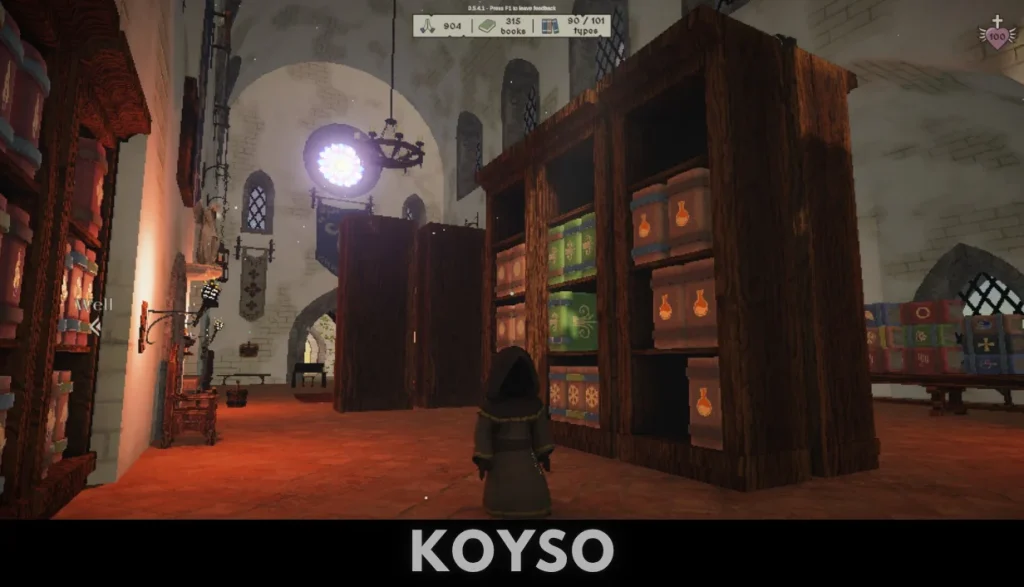
Daytime Library Management
The daytime period is primarily about organizing and expanding your library.
New books are delivered, and you need to place them on shelves. There is no single correct arrangement, so players have considerable freedom in deciding how the collection should look.
This makes organization a meaningful gameplay mechanic rather than a cosmetic activity.
Create Your Own Filing System
Because the books use symbols instead of conventional titles, players need to develop their own method for remembering them.
You could organize shelves according to:
- Similar symbols
- Frequently requested books
- Book size
- Shelf location
- Personal categories
- Areas of the library
- A combination of several systems
The best system is the one you can remember when the lights are low and a Scribe suddenly asks for a specific volume.
Stack Multiple Books
The game allows you to physically carry books in stacks rather than moving them one at a time.
This makes transportation faster when reorganizing large portions of the library.
However, the physics-based design means carrying and throwing books can also produce chaotic situations.
Books can tumble, pile up, and interact with the environment in ways that make the library feel more physical than a traditional management simulator.
The Memory Challenge
Memory is one of the defining mechanics of Monk Took Book.
During the day, you can calmly place books wherever you want. Later, Scribes request specific volumes, and you have to remember where they are.
The challenge becomes much more noticeable as your collection grows.
Imagine organizing hundreds of books and then receiving several requests during the night. If your filing system is confusing, finding the correct books can become surprisingly difficult.
This creates a natural gameplay progression:
- Start with a small collection.
- Learn the library layout.
- Develop an organization system.
- Add more books.
- Expand the shelves.
- Handle increasingly complicated retrieval tasks.
- Improve your monk’s abilities.
- Defend the collection after dark.
The result is a game where your own organizational habits directly influence how easy the later gameplay becomes.
Nighttime Gameplay and Library Defense
When night falls, the peaceful library changes.
Vermin, spirits, beasts, and other threats can attack the collection. Instead of simply managing shelves, you may need to protect your work.
The game gives your monk several ways to respond.
You can use:
- A dagger
- A crossbow
- A holy cross
- Melee combat
- Ballistic weapons
- Environmental interactions
Damaged books can also be repaired with a quill.
This creates an interesting contrast between daytime and nighttime.
During the day, the library encourages careful organization.
At night, it becomes a defensive environment where you must protect the results of your work.
Combat in Monk Took Book
Combat is not the only purpose of the game, but it adds another layer to the library-management experience.
Enemies can attack your collection, and you need to decide how actively you want to fight them.
The game includes both melee and ranged combat. A dagger can be used for close-range encounters, while a crossbow gives you a ranged option.
The holy cross provides another defensive tool.
Because the game includes physics and environmental systems, combat exists alongside the broader simulation rather than functioning as a completely separate mode.

Adjustable Difficulty and Relaxed Gameplay
One of the strongest features for players who prefer cozy experiences is the game’s granular difficulty system.
You can reduce, increase, or disable certain enemy-related challenges. Book delivery rates can also be adjusted to create a more relaxed experience.
This is particularly useful because Monk Took Book can appeal to different types of players.
If you enjoy pressure and survival elements, you can keep more threats active.
If you are primarily interested in organizing the library, you can reduce distractions and spend more time arranging shelves.
This flexibility means the game does not force every player into the same difficulty experience.
Character Progression and Blessings
Your work inside the library is rewarded by the Abbot with Blessings.
These rewards can be invested into your monk’s progression.
You can improve attributes such as:
- Strength
- Speed
- Carpentry
You can also use progression to expand the library itself.
For example, players can build additional shelves and unlock new chambers, allowing the collection to grow.
This creates a useful relationship between management and progression. The better you perform your duties, the more opportunities you have to improve both your character and your library.
Expanding the Legendary Collection
The long-term objective is not simply to organize today’s deliveries.
Your larger goal is to complete the Legendary Collection.
As the collection expands, the library becomes increasingly important and increasingly difficult to manage.
More books mean more opportunities for organization, but they also mean more locations to remember.
This makes expansion a double-edged sword.
A larger library gives you more room and progression opportunities, but it also increases the mental challenge of remembering where everything is stored.
First-Person and Third-Person Camera
Monk Took Book supports both first-person and third-person perspectives.
First-person gameplay can make the library feel more immersive, especially when carrying books, exploring dark corridors, and dealing with nighttime threats.
Third-person gameplay gives you a broader view of your character and surroundings.
Having both options allows players to choose the perspective that best fits their preferred way of playing.
Physics-Based Library Gameplay
The library is not simply a collection of static shelves.
The game features systems-based emergent gameplay, including physics for books and other environmental interactions.
You can carry books in large stacks and throw them across the environment.
Books can tumble and behave dynamically, creating situations that are sometimes useful, sometimes messy, and occasionally hilarious.
The game also features simulated flame and combustion, water-based fire suppression, and a day-and-night cycle.
This makes the monastery feel more like a functioning physical environment than a simple menu-driven management game.
Fire and Environmental Systems
Fire is another danger that can affect the library.
Because books are valuable and vulnerable, managing environmental hazards becomes important.
The game includes simulated flame and combustion, while players can use a pail of water to deal with fires.
This adds another layer of responsibility to library management.
You are not simply asking:
Where should this book go?
You may also have to think:
How do I protect the entire collection?
Monk Took Book Multiplayer
One of the biggest attractions of Monk Took Book is its multiplayer support.
The game supports online co-op for up to four players, meaning you can run the monastery with three other fellow monks.
Co-op can make the organizational gameplay much more entertaining because each player can contribute to different responsibilities.
One player might organize shelves while another retrieves books.
Another could handle library expansion, while someone else deals with nighttime threats.
This naturally turns the monastery into a shared workplace.
Co-Op Features
The multiplayer experience includes:
- Up to four players
- Public lobbies
- Private lobbies
- Steam invites
- Lobby join codes
- In-game text chat
- Proximity voice chat
These features make it possible to play with friends in different ways.
If you want a private monastery session, a private lobby is available. If you want a more social experience, public multiplayer provides another option.
Solo Gameplay
You do not need friends to enjoy the game.
Monk Took Book supports single-player gameplay, allowing you to manage the monastery alone.
Solo play may actually appeal to players who enjoy organizing games at their own pace.
You can create your own filing system, manage the shelves, expand the library, and deal with threats without coordinating responsibilities with other players.
The choice between solo and co-op therefore depends largely on your preferred experience.
Cozy Atmosphere With a Creepy Twist
The game deliberately combines cozy library management with darker medieval atmosphere.
The basic activity of organizing books can feel calm and satisfying.
The surrounding environment, however, introduces supernatural threats and nighttime danger.
That contrast is central to the game’s identity.
During the day:
- Books arrive.
- Shelves are organized.
- The library expands.
- You plan your storage system.
- You work toward the Legendary Collection.
At night:
- Scribes request books.
- Threats appear.
- The collection may be damaged.
- Fires can become dangerous.
- Combat becomes more important.
The result is a cozy-creepy experience rather than a conventional horror game.
Accessibility Options
Monk Took Book includes several options that let players customize their experience.
An arachnophobia mode is available for players who are uncomfortable with spiders. The game also provides granular enemy settings, allowing players to reduce or disable certain threats.
Additional customization includes:
- Full key rebinding
- Field-of-view slider
- Headbob slider
- Gamma slider
- Windowed or fullscreen modes
- Widescreen support
- Manual save
- Autosave
- Adjustable enemy intensity
- Adjustable book delivery rates
These options give players more control over how the game feels.
Monk Took Book Free Download PC: Is It Free?
If you are searching for Monk Took Book Free Download PC, it is important to distinguish between the full game and its free demo.
The full PC game is a paid release, while Monk Took Book Demo is available separately as a free demo. The demo lets players experience the core library-management concept before purchasing the full game.
Steam currently lists the full game at $8.99, with a launch discount shown at $8.09 until September 17, 2026. Pricing can vary by region and may change after the introductory offer.
Therefore, players looking for a legitimate free way to try the game should use the official demo rather than downloading unauthorized copies.
How to Download Monk Took Book on PC
The safest way to download the game is through an authorized PC distribution platform.
Official Download Steps
- Open Steam on your Windows PC.
- Search for Monk Took Book.
- Open the official game page.
- Check whether your PC meets the requirements.
- Purchase the full game if you want the complete experience.
- Select the installation option.
- Choose your preferred storage location.
- Wait for Steam to finish downloading the game.
- Launch Monk Took Book from your Steam Library.
If you only want to test the gameplay first, look for the Monk Took Book Demo, which is listed as a free demo.
Monk Took Book Demo
The demo is particularly useful for players who are unsure whether the game’s unusual combination of organization and memory mechanics will suit them.
The demo allows players to become familiar with the monastery, learn how book placement works, and experience the basic gameplay loop.
The demo listing identifies it as a free playable demo and includes both single-player and online co-op features.
It is a good starting point if you want to understand the game’s core mechanics before purchasing the complete version.
Monk Took Book PC System Requirements
Before starting the Monk Took Book PC Download, make sure your computer meets the official requirements.
| Requirement | Minimum | Recommended |
|---|---|---|
| Operating System | Windows 10 or later | Windows 11 |
| Processor | Intel Core i5 or equivalent | Desktop Intel Core i9 or equivalent |
| Graphics | Desktop NVIDIA GTX 1050 4GB or equivalent | Desktop NVIDIA RTX 2070 8GB or equivalent |
| Integrated Graphics | Not supported | Not specified |
| Platform | PC | PC |
The official listing specifically notes that integrated GPUs and lower-spec mobile laptop GPUs are not supported.
Minimum PC Requirements Explained
A desktop system with a Core i5-class processor and GTX 1050 4GB-class graphics card is the baseline specified by the developer.
If you are using a laptop, check your exact GPU model rather than assuming it will meet the requirements. The official specification warns that lower-spec mobile laptop GPUs are not supported.
Recommended PC Requirements
For a smoother experience, the developer recommends Windows 11, a desktop Core i9-class processor, and an RTX 2070 8GB-class graphics card.
Players planning to use higher visual settings should pay particular attention to the graphics requirement.
How to Get Better Performance
If your PC is close to the minimum requirements, several general settings can help improve performance.
1. Close Background Applications
Before launching the game, close unnecessary programs that consume CPU and memory resources.
2. Keep Graphics Drivers Updated
Use the latest stable driver available for your graphics hardware.
3. Lower Demanding Graphics Settings
If performance is inconsistent, reduce graphics settings before changing other system options.
4. Use Fullscreen Mode
Try fullscreen mode if you experience unusual performance while running the game in a window.
5. Keep Enough Storage Space
Avoid filling your drive completely. Leave sufficient free space for Windows, Steam, updates, and temporary files.
Key Features of Monk Took Book
The game’s strongest features include:
- Medieval monastic library setting
- Cozy-creepy atmosphere
- Library management gameplay
- Memory-based book retrieval
- Hundreds of books to organize
- Distinct symbols on book covers
- Player-created organization systems
- Day-and-night cycle
- Character progression
- Strength, speed, and carpentry upgrades
- Library expansion
- New shelves and chambers
- First-person perspective
- Third-person perspective
- Physics-based book interactions
- Melee combat
- Ranged combat
- Dagger
- Crossbow
- Holy cross
- Fire and combustion simulation
- Water-based fire suppression
- Book repair
- Solo gameplay
- Online co-op
- Up to four players
- Proximity voice chat
- Public and private lobbies
- Steam invites
- Lobby join codes
- Adjustable enemy difficulty
- Adjustable book delivery rates
- Arachnophobia mode
- Full key rebinding
- Manual and automatic saving
- Field-of-view controls
- Widescreen support
- Steam Cloud
- Steam Achievements
- Family Sharing
These features are listed across the official Steam game information.
Tips for Playing Monk Took Book
Build a Consistent Organization System
Do not randomly place books if you can avoid it.
Choose a system early and keep using it.
Consistency becomes increasingly valuable as the library expands.
Keep Frequently Requested Books Accessible
If certain areas or books are used frequently, consider placing them somewhere easy to reach.
Learn the Library Layout
Knowing where your major shelves and rooms are located can save considerable time.
Upgrade Useful Skills
Blessings can improve attributes such as strength, speed, and carpentry.
Choose upgrades based on the tasks you perform most often.
Expand Carefully
More shelves and chambers give you more space, but they also create more locations to remember.
Expansion should make your organizational system better rather than simply larger.
Play With Friends
If you enjoy cooperative management games, the four-player option can make the experience much more social.
Assigning responsibilities among players can also make large library tasks easier.
Adjust the Difficulty
Do not hesitate to reduce enemy intensity if combat is distracting you from the part of the game you enjoy most.
The game is designed to give players control over several aspects of difficulty.
Why Monk Took Book Is Different
There are plenty of management games, puzzle games, and medieval games, but Monk Took Book combines these concepts in an unusual way.
Its main challenge is not simply making money or maximizing production.
Instead, the game asks you to remember your own decisions.
You decide where books go.
Then the game tests whether you can remember those decisions later.
That simple concept creates a surprisingly personal progression system because your organization skills become part of your gameplay ability.
The library effectively becomes a map created by your own memory.
Who Should Play Monk Took Book?
Monk Took Book is a strong choice for players who enjoy:
- Cozy management games
- Organization and sorting games
- Memory challenges
- Medieval environments
- Simulation games
- Immersive sims
- Physics-based gameplay
- Light combat
- Atmospheric experiences
- Solo management games
- Cooperative games
- Games with adjustable difficulty
It may be especially appealing if you enjoyed games where creating your own organizational system is part of the fun.
Who Might Not Enjoy It?
The game may be less suitable for players who want constant action.
Its central gameplay revolves around organizing, remembering, retrieving, expanding, and managing a library.
Combat exists, but it is not the sole focus.
Likewise, players who dislike memory-based tasks may find the retrieval mechanics frustrating as the library becomes larger.
Final Verdict
Monk Took Book Free Download PC offers a creative combination of cozy management, memory challenges, medieval atmosphere, physics-based interactions, and light combat.
Its biggest strength is the way it makes organization meaningful. You are not simply arranging objects for visual satisfaction. You must remember where you placed them because the game eventually asks you to find them again.
The day-and-night structure gives the experience another layer. Daytime is focused on building and organizing the library, while nighttime introduces requests, danger, combat, and environmental threats.
The ability to play alone or with up to three other players makes the concept even more flexible. Players who prefer a relaxed experience can also adjust enemy intensity and book delivery settings.
For anyone interested in a management game that feels different from conventional city builders, shop simulators, or farming games, Monk Took Book is worth checking out.
The free demo is the best option for players who want to test the core mechanics before purchasing the full PC release.
Frequently Asked Questions
Is Monk Took Book available on PC?
Yes. Monk Took Book is available for Windows PC through Steam. The full game was released on September 3, 2026.
Is Monk Took Book free to download?
The full game is a paid PC release. However, an official free demo is available for players who want to try the gameplay before purchasing the complete version.
Can I play Monk Took Book offline?
The game supports single-player, but the official listing also identifies online interactivity and online co-op features. Players should use the official Steam version and check the current platform requirements for their preferred mode.
Does Monk Took Book support multiplayer?
Yes. The game supports online co-op for up to four players.
Can I play Monk Took Book alone?
Yes. Single-player is officially supported.
How many players can play together?
Up to four players can participate in online co-op.
Does Monk Took Book have combat?
Yes. The game includes melee and ranged combat, including a dagger, crossbow, and holy cross.
Can I turn off enemies?
The game includes granular difficulty options that allow players to reduce, increase, or disable some or all enemies.
Does Monk Took Book have a demo?
Yes. Monk Took Book Demo is available as a free demo on Steam.
What is the main objective in Monk Took Book?
The main long-term objective is to manage the monastic library and work toward completing its Legendary Collection while handling book deliveries, upgrades, expansion, and nighttime threats.
Does Monk Took Book support first-person gameplay?
Yes. The game supports both first-person and third-person perspectives.
What GPU is required for Monk Took Book?
The official minimum specification lists a desktop NVIDIA GTX 1050 4GB or equivalent. Integrated GPUs and lower-spec mobile laptop GPUs are not supported.
Can I organize the books however I want?
Yes. The game allows players to place books on shelves according to their own organization system.
Does Monk Took Book support Steam Cloud?
Yes. Steam Cloud is listed among the game’s features.
Does Monk Took Book have achievements?
Yes. Steam Achievements are supported.
Does Monk Took Book support Family Sharing?
Yes. Family Sharing is listed among the game’s Steam features.
What makes Monk Took Book different from other simulation games?
Its central mechanic combines library management with memory. Players must remember where they placed books because Scribes later request specific volumes.
Should I try the demo before buying?
Yes. If you are unsure whether the organization and memory mechanics appeal to you, the official free demo provides a convenient way to test the game’s core concept before purchasing the full release.


